THE SHORT ANSWER
The ideal customization platform does not dictate the final idea.
Daggerr Nightmare works as a canvas because its visual identity is strong but not crowded. The production knife provides a recognizable silhouette, titanium handle scales and a modern MagnaCut blade, then leaves substantial surfaces open for another maker—or the owner—to add a second layer of meaning.
That is different from calling every plain-handled knife “custom-ready.” Useful space must be in the right place. The composition also has to coexist with the pivot, lock, fasteners, opening system and the way a hand moves across the handle. Nightmare's advantage is not emptiness alone; it is the relationship between open surface and an already coherent object.
THE CUSTOMIZATION TEST
Six features make the Nightmare a practical starting point.
| Design marker | Why it helps | What still needs care |
|---|---|---|
| Broad titanium scales | Large, relatively uninterrupted faces give an artist room for a composition rather than a small decorative accent. | The lock, pivot, fasteners and scale edges still need functional clearance. |
| Monochrome foundation | Blade and handle begin as one restrained visual field, so a new image can become the dominant language of the knife. | A finished custom concept may be much less discreet than the production version. |
| Two base finishes | Bead-blasted titanium with a satin blade offers a light canvas; the black PVD version creates a darker, higher-contrast starting point. | Different coatings and engraving depths require different processes and aftercare. |
| MagnaCut blade | The current version gives the project a modern working blade rather than turning the knife into a display-only object by default. | Decorating a blade can affect its finish and should not interfere with the edge, lock interface or heat-treated geometry. |
| X-Lock construction | The lock keeps the mechanical identity distinct from the broad decorative faces of the scales. | A professional customizer must protect tolerances and moving surfaces during disassembly and finishing. |
| Three sizes | The 99 mm standard model, Nightmare 77 and Nightmare 63 let the owner choose a different scale for both carry and artwork. | Blade length and locking-knife rules vary by jurisdiction; customization does not change those restrictions. |
The model-family details reflect Daggerr's June 2025 product article. Exact finish, opening method and grind vary by version; confirm the intended base knife before commissioning custom work.
RESTRAINT AS A DESIGN TOOL
The production knife supplies structure, not a finished story.
Inside Daggerr, the uncustomized Nightmare has sometimes been described, with a degree of affectionate irony, as a “nudist knife.” The nickname comes from its visual continuity. In the light version, the satin blade and bead-blasted titanium sit close together in tone. In black, the PVD treatment carries the dark field across most of the object, interrupted mainly by the hardware.
This continuity matters because engraving is not forced to compete with a collection of unrelated inserts, inlays, colors and logos. A customizer can treat the two scales as connected panels, use the blade as part of the composition, or deliberately leave areas untouched. The knife already has a silhouette; the artwork can concentrate on atmosphere, depth and narrative.
Nightmare is recognizable before customization, but restrained enough to survive a radical visual intervention. The best result should still read as the same knife—only now as one person's knife.
CASE STUDY · THREE NUMBERED KNIVES
When the Nightmare theme became literal.
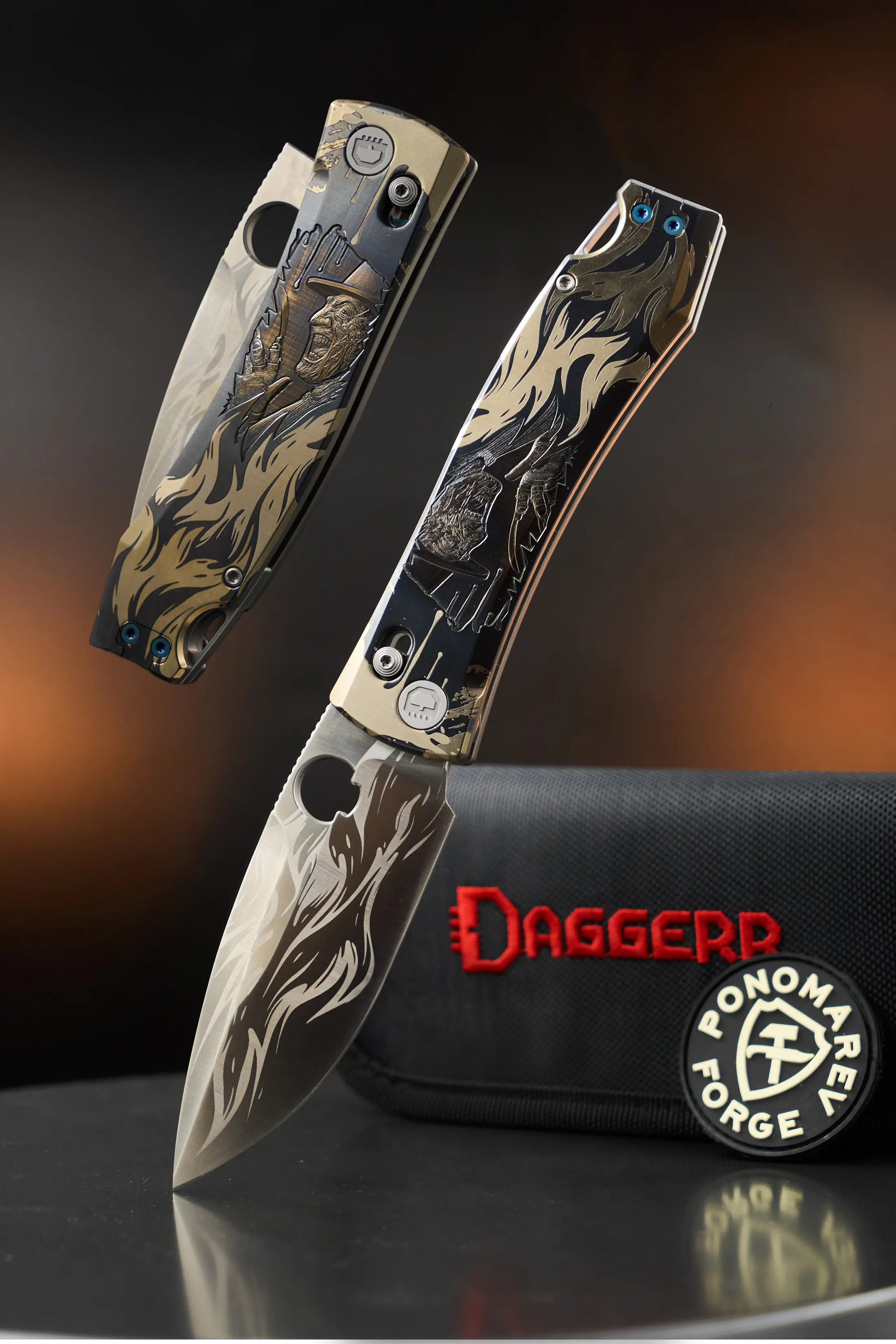
A serial platform, treated as a connected artwork.
Daggerr invited Ponomarev Forge to create three individually numbered Nightmare knives around a horror-film composition. The workshop used the scales and blade as one narrative surface: figures, flame-like movement, contrasting metal tones and small blue hardware accents continue across parts that normally read as separate components.
Two examples entered the personal collections of Daggerr's founders. The third was offered at auction, starting at the regular retail price of the production model. The project was deliberately limited to three pieces—not a new factory variant, but an example of what the underlying design could become in the hands of a specialist workshop.
The collaboration is useful as more than a dramatic showcase. It demonstrates the central requirement of successful customization: the added imagery must respond to the object beneath it. Here the long diagonals of the composition follow the handle, the dark fields echo the coated surfaces, and the engraving works around visible mechanical landmarks rather than pretending they do not exist.
HONEST TRADE-OFFS
Customization adds identity—and removes reversibility.
Deep engraving, refinishing, coating removal and blade decoration are permanent decisions. They may change surface texture, corrosion behavior at exposed areas, tolerances or manufacturer support if the work reaches functional parts. Monetary value is equally personal: an expensive commission can make a knife irreplaceable to its owner while narrowing the number of future buyers who share the same idea.
- 01 · Protect the mechanismKeep engraving, abrasive work and coatings away from the pivot, lock interface, bearing or washer tracks, screw seats and blade edge unless the specialist has planned for them.
- 02 · Decide how the knife will be usedA carry knife needs finishes that tolerate pocket wear and handling. A display piece can prioritize depth, contrast and delicate surface effects.
- 03 · Check service and warranty firstAsk both the knife maker and customizer what future disassembly, sharpening and repair will remain possible after the work.
- 04 · Choose the artist for the processLaser marking, hand engraving, sculptural relief, anodizing and mixed finishes produce different depths and age differently. A strong illustration alone does not guarantee sound metalwork.
BUYER & COLLECTOR FIT
Choose the Nightmare as a canvas if the base knife already fits.
- Choose it if…you want a large, visually coherent titanium folder whose broad surfaces can carry a complete composition rather than a small monogram.
- Keep it unmodified if…the restrained titanium-and-steel look is precisely what attracts you, or you value easy resale and factory-standard servicing.
- Look for a different base if…you need a compact, discreet office knife, prefer removable scales that can be customized off the knife, or want a project that can be returned to stock.
- Verify before carrying if…local rules restrict blade length, one-hand opening or locking folders. The standard Nightmare uses a 99 mm blade; the family also includes 77 mm and 63 mm versions.
SOURCE TRAIL
Product, material and workshop references.
Specifications and variant details come from Daggerr's current model-family article. The three-knife collaboration, numbering and auction history come from Daggerr's project archive and the supplied project photograph. Material context is linked to the steel developer's technical account; workshop background comes directly from Ponomarev Forge.